
California City Directory Holdings
California has no single statewide city directory. Libraries hold local runs, and the publisher, format, and years differ by place. The table starts with two deep city collections and the State Library’s statewide catalog, which can point to a physical volume or another digital holding. Treat every range as a collection description, not a promise that each year is complete.
| Collection | Years | Publishers | Where Held | Access |
|---|---|---|---|---|
| San Francisco city directories | 1850-1960 microform; 1875-1982 print | Kimball; A.W. Morgan and Parker; LeCount and Strong; Langley; Polk and Crocker-Langley | San Francisco Public Library (SFPL) | Microform and print |
| San Francisco reverse directories | 1953-1982; Haines volumes 1976-current | Varies by volume | SFPL | Library collection |
| Los Angeles city and street directories | Searchable 1875-1987; early holding from 1873 | Varies by city, region, and volume | Los Angeles Public Library (LAPL), ResCarta | Search and browse online |
| California city/county directory catalog | Holdings vary by place and year | Varies by cataloged item | California State Library | Catalog-style discovery |
| San Francisco telephone books | 1899-current microform; 1921-2006 print | Varies by year | SFPL | Microform and print |
Year gaps, publisher changes, and shifts in a book’s geographic reach matter. A directory may cover a city, a nearby group of towns, or a region, and its title page is the best way to check which. An unlocated entry in one year does not establish that a household was absent. Use an adjacent year, phone book, census, or local history source to bridge the gap.
The California State Library directory catalog searches by county and city name. The screen shows the place-based starting point for a collection search.
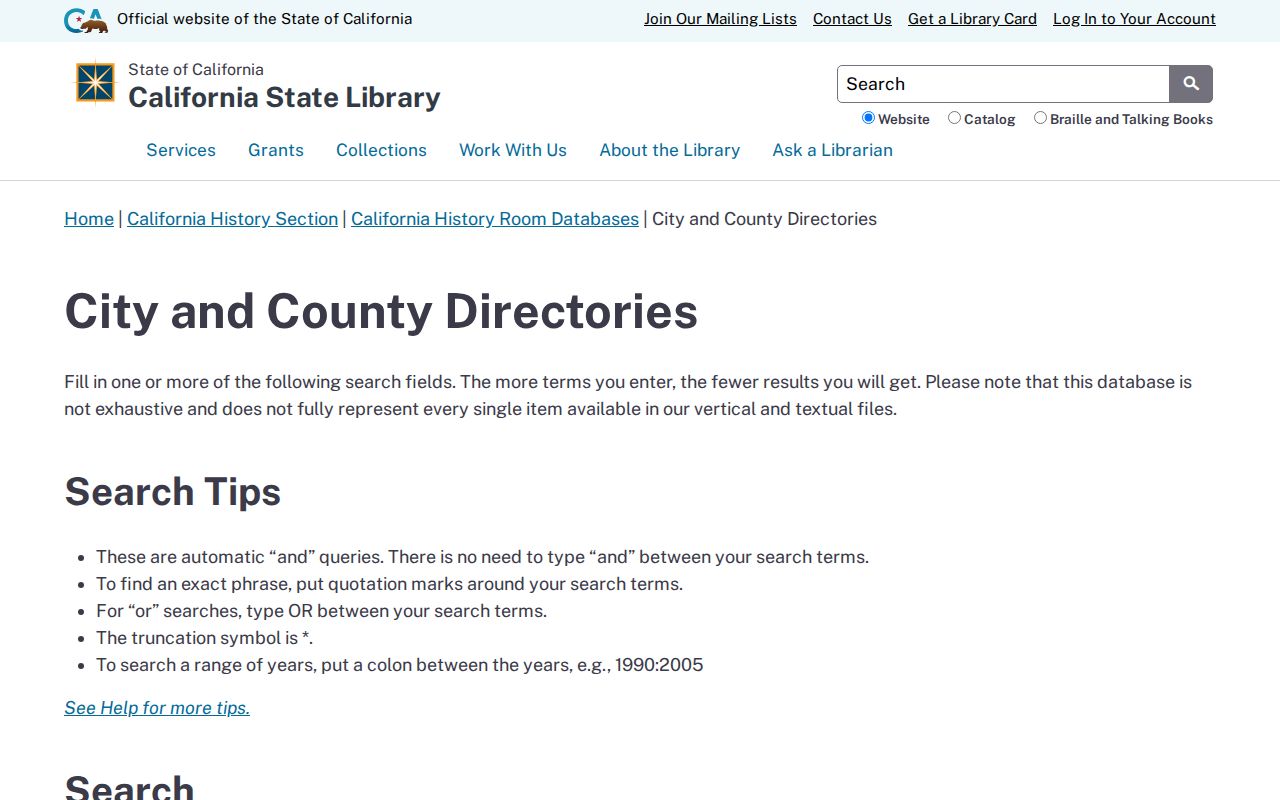
Use a result to ask the holding library about the volume, format, access rules, and any missing issues.
Find California City Directory Catalogs
The California State Library city and county directory database searches by place and helps identify what the library or a partner holds. A catalog result may lead to a book, microform, digitized copy, or another institution; it is not always a full-text name search. The State Library’s separate telephone-book database is a useful second pass when a city directory is missing. A blank result means the item was not found through that catalog, not that no one lived there.
The California History Section also answers reference questions at 900 N Street, Room 200, Sacramento, CA 95814, by phone at (916) 654-0176, or by email at cslcal@library.ca.gov. Its research guide lists weekday hours from 9:30 a.m. to 4 p.m. and other name indexes. Ask for the city, county, likely year, and whether address-to-occupant volumes exist. A librarian may point to a physical or microform run that a web search does not show.
San Francisco City Directories by Year
SFPL’s Magazines and Newspapers Center lists San Francisco directories on microform from 1850 through 1960 and in print from 1875 through 1982. Reverse directories cover 1953-1982, with Haines volumes from 1976 to the current run. Telephone books add another series: microform from 1899 to current and print from 1921 through 2006. The year-by-year list names early publishers such as Kimball, A.W. Morgan, Parker, LeCount and Strong, Langley, and later Polk or Crocker-Langley editions. Those names and dates change across the run, so check the individual volume rather than assume one publisher made every year.
SFPL’s San Francisco year list identifies titles and known gaps. The library also lists a 1949 Chinese directory, a 1933 San Francisco, Colma, and Daly City address list, and a 1940 House & Street Directory. These special volumes can give a lead when a general alphabetic listing misses a name or uses a different language form. The Magazines and Newspapers Center lists its contact number as 557-4453; ask about format and reading-room access before making a trip, especially when a target year is only held on microform.
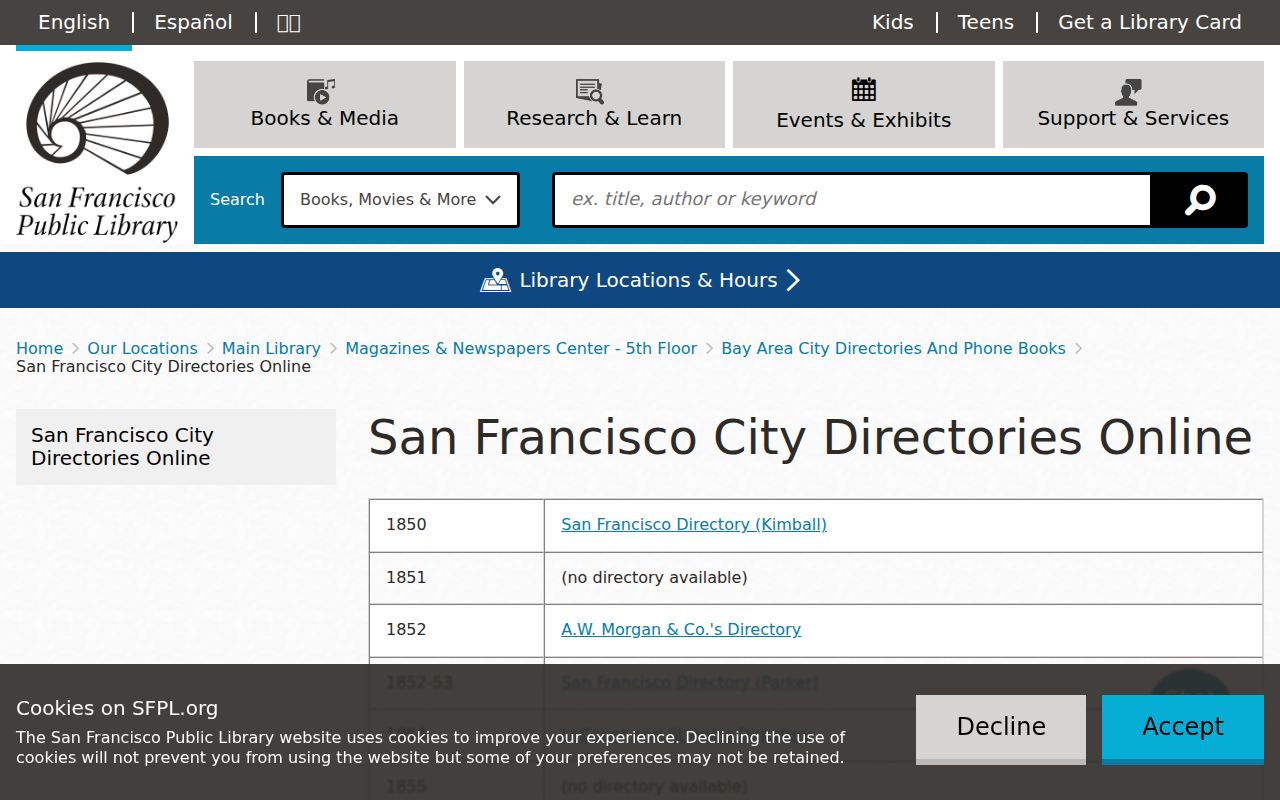
Use the year list to pick a likely volume, then read its title page and front matter for area coverage, publisher, and any known break in the sequence.
California’s Census Gap and Directories
San Francisco’s federal census for 1850 was lost, as were the 1850 schedules for Contra Costa and Santa Clara. For an early San Francisco household, a surviving directory can therefore be the first dated address evidence found. That is a gap in one record series, not proof that a person was absent from the city. SFPL’s house-history research guide sets out a way to use a reverse directory, then follow the name in a forward listing and test it against deeds, tax material, census, newspapers, and probate.
A second break affects the whole country: most of the 1890 federal population schedules were destroyed in a 1921 fire. The National Archives census guide describes the surviving census years and the 72-year public-release rule. A directory can help span the decade, but it records a publisher’s dated report, not a full household count or a continuous record of residence.
Los Angeles Digitized Directory Runs
LAPL’s digitized city and street directory collection is searchable by name or address for 1875-1987. The early shelf reaches to 1873, before the searchable run. Its ResCarta browser showed 184 digitized items at research time, including Los Angeles City Directory volumes from 1873, 1875, 1878, 1879-80, 1881-82, and 1883-84, plus a Southern California Directory from 1875. The items do not all cover the same place or span, so open the volume record and image rather than relying on a search-result label alone.
The LAPL ResCarta browse view sorts the digitized items and exposes the scanned volumes. LAPL’s genealogy service information also reports Los Angeles directories from 1873-1942 on film or paper, census microfilm, historical newspapers, and Sanborn maps. It offers directory research for people who cannot visit or search the shelves; check the library’s current service terms before making a request.
The captured ResCarta browse screen shows how a researcher can move from a catalog entry into a digitized volume.
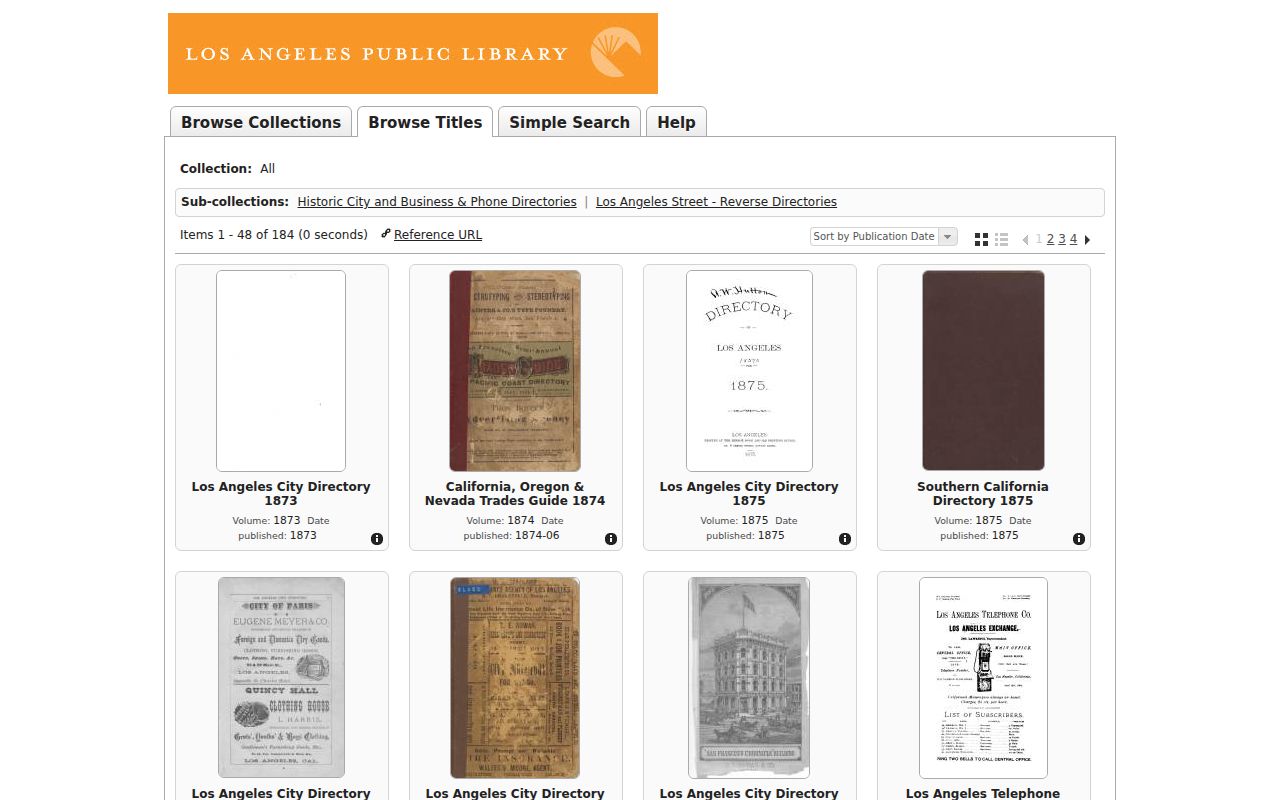
Once a volume opens, note its place range and publication dates before comparing the listed address with a later source.
Read a California City Directory Entry
A printed line can bring together a name, home address, spouse or household notation, occupation, and sometimes a business address. Which fields appear depends on the publisher and year. The inventory below is a reading aid, not a claim that every California volume used the same symbols. Record the page and wording as printed, including initials and spelling, before trying to match the person to a census or family record.
| Name | Copy the entry as printed; compare nearby alphabetic entries and other years for spelling or initials. |
|---|---|
| Address | Record the number and street exactly, then check maps or another year if the address looks different. |
| Spouse or household cue | Some entries name a spouse or use a household mark; confirm its meaning in that volume’s key. |
| Occupation or business address | These details can help distinguish people with the same name; they do not prove who else lived at the home. |
| Ownership mark | Use only if that publisher defines it. Do not infer owner or renter status from an unexplained letter. |
- Reverse or criss-cross directory
- A street-order list that can lead from an address to a printed name for a given edition.
- Householder index
- An index organized around a household or address; its scope and labels depend on the book.
- Abbreviation key
- The volume’s guide to shortened terms and marks, often near the front matter. Read it before decoding an entry.
Check the title page and key along with the entry. Publisher conventions vary by year, and one mark can change what a line seems to say. Keep the exact volume, page, and spelling in your notes so a later check can return to the same source.
Trace a California Household by Directory Year
For family history, follow one person through several dated sources instead of treating a single listing as a life story. Pair a directory with the nearest census year, but keep each source’s own date and coverage. The California previous residents page focuses on tracing one address backward through owners and past households.
- Start with a person’s known city and a narrow year range. Search the local directory catalog, then confirm the volume’s place coverage.
- Copy the name, address, household notation, and publisher details from the image or book. Save the page number and the volume’s key.
- Check a reverse section if one exists, then look up the name in the alphabetic section for more household details.
- Compare with a nearby census year. Census schedules can show household relationships that a directory omits, but the two records may have different dates.
- Test a likely match with an obituary, newspaper notice, cemetery record, deed, or another family source.
If a name vanishes, the person may have moved, died, changed how the name was printed, or simply gone unlisted. Search a spouse, variant spelling, old street name, and neighboring year before choosing one explanation.
California Directory Research Beyond the Shelf
When a library run stops, California researchers have several other paths. The State Library points readers to FamilySearch indexes and to Ancestry Library Edition at its locations. NARA census images, city-library newspaper and obituary collections, cemetery and church registers, university archives, and local historical societies may add a date or family link. The California State Archives county guide describes Great Registers, affidavits of registration, naturalization indexes, and other county materials; these are separate series with their own limits.
Sanborn fire-insurance maps can add building context. The Library of Congress Sanborn guide describes search fields for state, city, date, sheet, and notes; its collection begins in 1867. A map may show a building footprint, material, stories, or use. It does not name the household. Keep it beside, not in place of, a directory or family record.
Regional history can point to the next useful shelf, but it cannot identify a person by itself. Gold Rush and early-statehood research may lead to pioneer files, naturalization, mining-town directories, land claims, and newspapers. A San Francisco address may call for Chinese-language directories and urban map sheets, while a Southern California property trail may connect LAPL directories with local permits and neighborhood maps. Keep that regional context as a search aid, then verify every name and address in a dated record.
For current city-held files such as permits or cemetery registers, the city department or custodian is the source; ask at its public counter, by phone or email, or through a California Public Records Act request for an existing disclosable record. Local retention varies, and older paper material may sit with a library, county archive, or historical society instead.