
California Resident Lookup Record Map
Each California system answers a narrower question. Choose by county, time and record type, then compare identifiers. An owner, court party, voter or license holder is not necessarily a current occupant.
| Record | What It Confirms | Where to Search | Access |
|---|---|---|---|
| Assessor parcel record | Parcel and any public owner or assessment fields, not every occupant | County assessor or parcel viewer | Fields and online access vary by county |
| Recorder index | Recorded names and title-related documents | County recorder or clerk-recorder | No single statewide deed index |
| Superior Court case index | A case filed under a party name | Superior Court for the county | Portal, account, fee and copy rules vary |
| Vital record | A birth, death, marriage or dissolution event | CDPH or the county custodian | Copy type and requester eligibility matter |
| Voter record | Your own status or a qualified request file | Secretary of State or county elections office | Other-voter information is restricted |
| License or entity filing | A public professional or business role | DCA, a board or Secretary of State | A listed business address is not a home |
California's 58 counties retain many records, with local search and copy rules. Compare record numbers across custodians. Use the California street directory for address-wide searches; older names belong in city directory collections.
Orange County Court Search Example
California's 58 Superior Courts keep county case records; the statewide self-help site has no case data. Orange County is the inspected example. Its public Case Name Search requires account enrollment and a filing-date range. The name-search screen begins with account login or enrollment.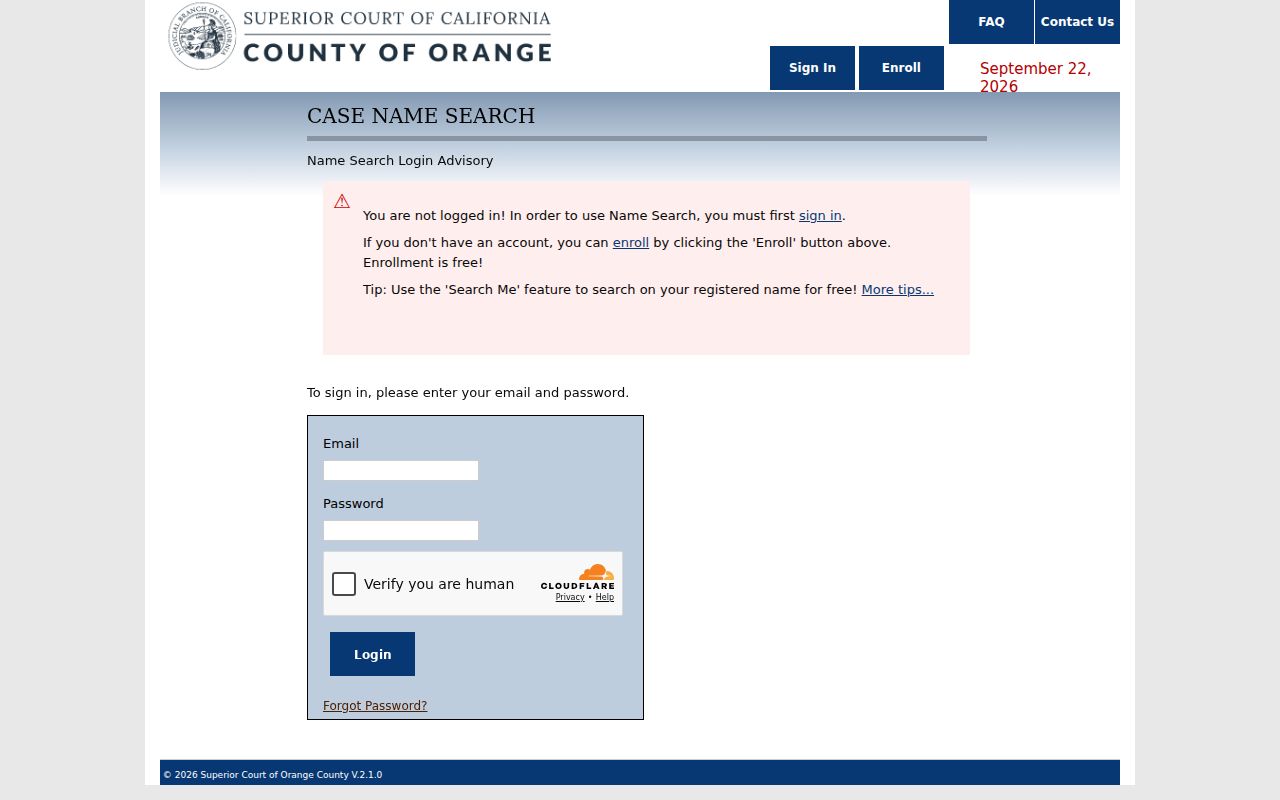 Public name searching requires an account.
Orange charges $1.50 for one credit; packages cost $5 for five, $9 for ten, $70 for 75 or $400 for 30-day unlimited searches. Packages are nonrefundable; the account holder's own “Search Me” query is free.
Case/calendar mode accepts a case number, person, business or calendar query. Person search needs a two-character last name and date range; first and middle names can narrow it. Dates use MM/DD/YYYY, and the end must be later. Business names also need two characters. Exact or similar match and all-case or criminal options are available; alias search is not.
The Orange County case-search screen shows number, person, business and calendar modes.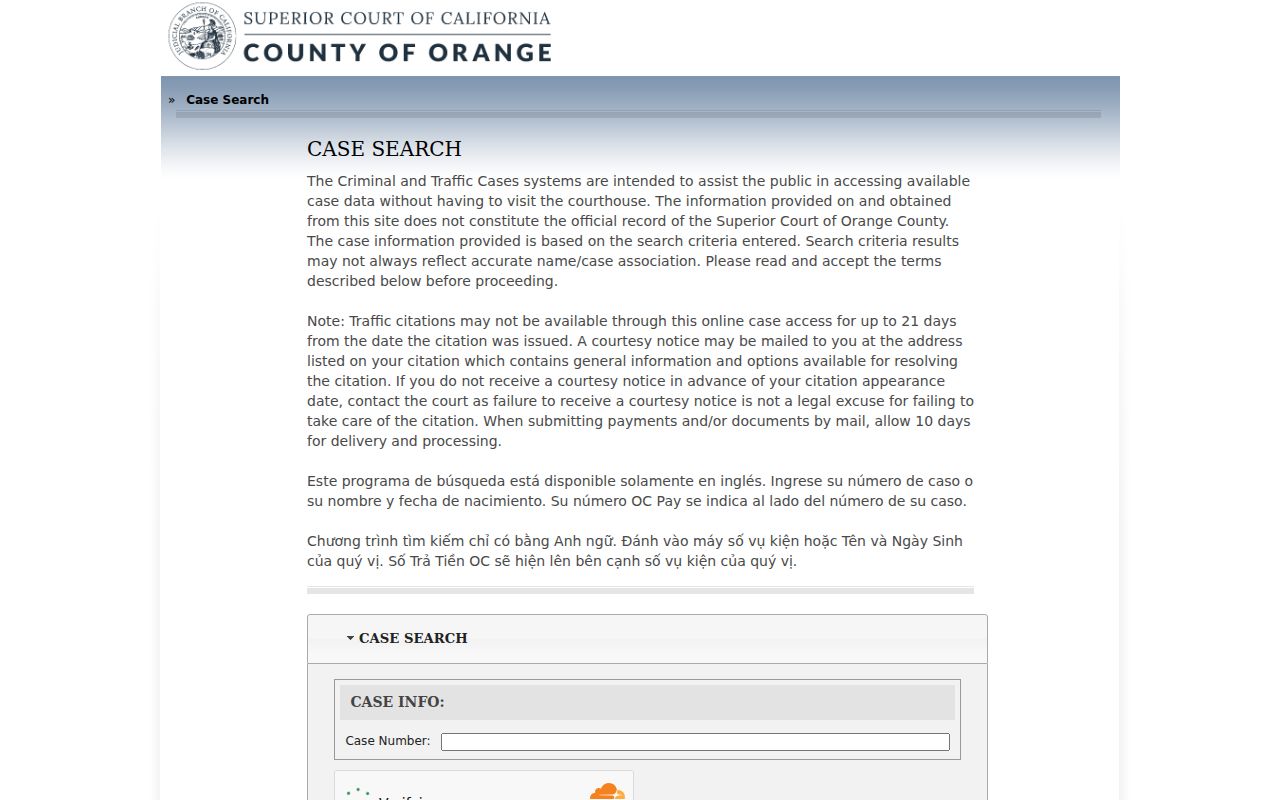 The result list is an index view, not the official record.
Orange County Court Result Inventory
Orange's sample inventory is an index, not the official record; use its case number to request a file.
| Visible field | How to read it |
|---|---|
| Case number and party name | Use the case number to request the file; a name match is only a lead. |
| Filing date | Places the filing in time but does not state a current outcome. |
| Calendar details | May show Justice Center, courtroom, prosecutor and hearing date. |
| Hearing information | Can list scheduled and past appearances. |
| Participant or co-defendant rows | Can show role, agency, name, release status and status date. |
Sealed, confidential, juvenile and other restricted cases may not appear. Courthouse public-access computers may show more; clerks can confirm basic case numbers or hearing dates by phone. Orange takes specific-copy requests at the counter or by mail. Some prior-year criminal indexes are office-only, and mail requests usually take 7–10 working days. For older files, ask the county archive or law library about finding aids.
Note: Orange County's account, credit and copy rules are local examples; check the correct Superior Court before relying on them.
Checking Identity Across California Records
A shared name is weak evidence. Keep an identity ledger and confirm a match with an independent custodian. Compare at least two details and dates; never use a protected identifier to force a match.
- Write the full name and spelling, county, approximate age or event date, and address period.
- Choose the county court, assessor or license board that fits the question; note its search mode and date range.
- Save a case, document, license or parcel number with the source and search date. Mark each fact direct, indexed, inferred or not verified.
- Compare a separate record family and check its dates and place names before treating two records as one person.
- Docket
- A court's ordered list of filings and events. It helps locate a document, but does not prove identity or outcome.
- Index and image
- An index holds search details; an image is a scan of the underlying document when available.
- Certified copy
- A copy the custodian attests is official. Certification does not make a record public or prove a name match.
For adoption or birth-parent questions, California's Department of Social Services sets out role-specific consent and court routes in its official adoptee information. A confidential intermediary may be part of the process; a public directory is no substitute. Record an absent hit as not located within the search scope.
For an heir search, follow an obituary or death record to the probate docket, then track the estate representative, recorded transfer and final distribution if public. Compare case and instrument numbers, checking the death, property and domicile counties because they may differ.
California Vital Records and Copy Rules
Birth, death, marriage and dissolution records connect people to an event, but they are not an open roster. Custody depends on the event and record type. A CDPH copy, a local registrar copy and a Superior Court decree are different records. Use the right California custodian and record-specific application for each event.
| Record | California custodian and route | 2026 CDPH fee |
|---|---|---|
| Birth | Local registrar for current year and one prior year; county recorder for all years; CDPH state copy. | VS 111, $31 |
| Death | Local registrar for current year and one prior year; county recorder for all years; CDPH state copy. | VS 112, $26 |
| Public marriage | County recorder where the license was issued, or CDPH. | VS 113A, $19 |
| Confidential marriage | County clerk where licensed; CDPH does not keep confidential marriage records. | Follow the issuing clerk's process |
| Dissolution certificate | CDPH certificate; request a divorce decree from the Superior Court that granted it. | VS 113B, $18 |
| Fetal death or still birth | Specialized county or state forms; a local still-birth fee may differ. | VS 12, $23; VS 13E, $28 |
Authorized copies are limited to the registrant, specified close relatives, court-authorized parties and certain government representatives. The record-specific form and notarized VS 20 sworn statement are part of that route. Where offered, an informational copy cannot establish identity; confidential birth sections have narrower rules. Applications ask for the event, requester relationship, copy type, payment and signature. CDPH accepts mail requests; call (916) 558-1784 or check local phone and counter routes.
2026 California Vital Copy Fees
The state fee schedule took effect January 1, 2026; local county charges may differ. CDPH retains a fee when no record is found. Its average certified-copy wait is four to six weeks, and amendments average seven to nine weeks. Use the correct VS form and notarized statement, do not send cash, and check the current CDPH fees before mailing. A missing signature or payment can cause rejection.
Note: An informational copy is still a certified record copy, but its printed restriction means it cannot establish identity.
California Voter Records Have Limits
The Secretary of State's voter-status tool checks a person's own registration. Authentication requires an exact match to California driver-license or ID details, or the last four Social Security digits. It returns the registered name and party, polling place and ballot status, not a public name-to-address search.
The California voter-status screen below requires the voter to authenticate their own record.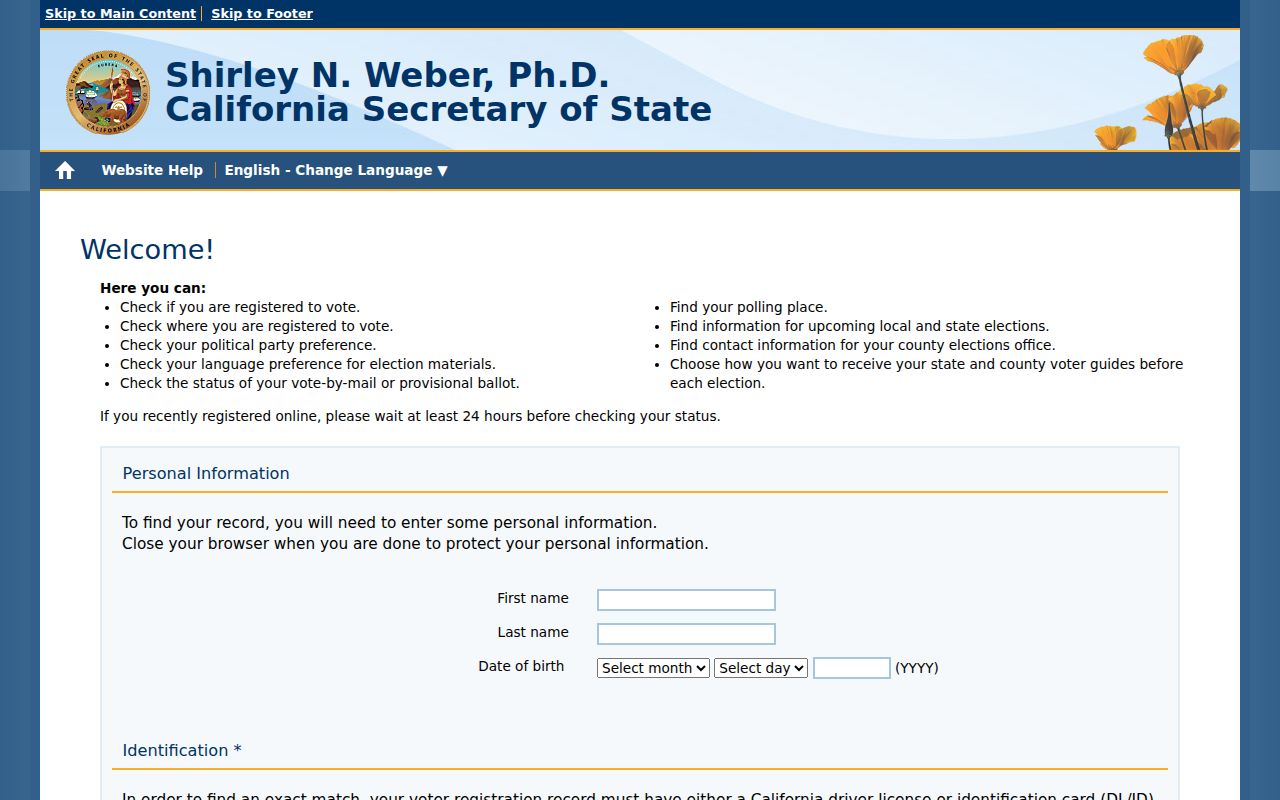
Voter data is not ordinary California Public Records Act material. Qualified requesters may apply for statewide, county or up-to-ten-specific-voter files for an allowed election, political, scholarly, journalistic or government purpose. The Secretary of State's voter-file instructions require ID, a purpose statement and wet signature; apply by mail or in person, not by email or fax.
Possible fields include name, address, party, status, county, precinct and voting history. Driver-license numbers, Social Security digits, signatures and ballot selections are excluded. A file is dated registration data, not proof of current occupancy or family ties.
California License Records Show Public Roles
The Department of Consumer Affairs search supports Boards and Bureaus, License Type or Number, Business Name, First Name, Last Name, Registry Number and Advanced Search. Its monthly file can show agency, license, public address, issue and expiration dates, and status. These fields confirm a credential or public role, not a home.
The California DCA license screen below shows board, license, business and person search choices.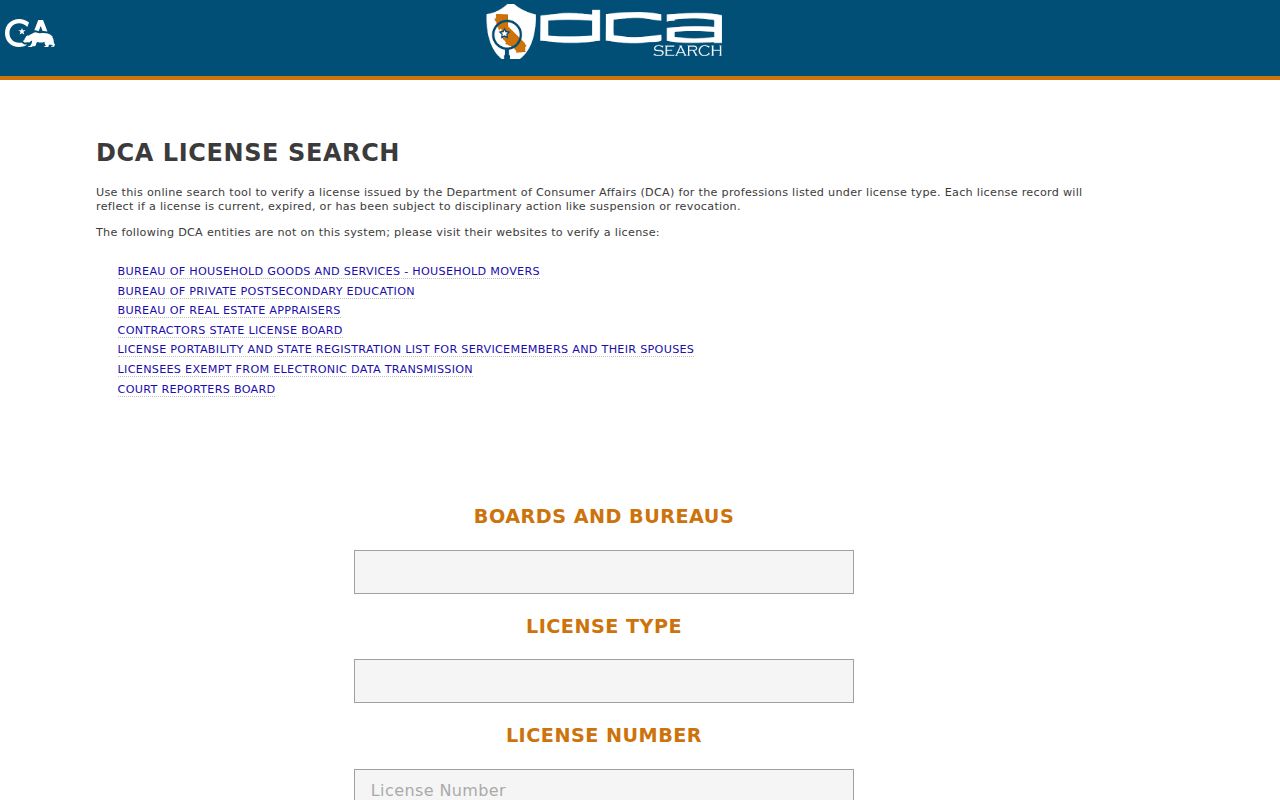
DCA covers more than 280 license types and 3.4 million licensees. CSLB, the State Bar, teacher credentials and some boards use separate systems. Prefer a license number to a common name. Secretary of State BizFile can show an entity's status, address, agent and filed officers or managers. These public addresses may belong to a business or service provider, not a person's home.
California Public Records Requests for One Person
The California Public Records Act (Gov. Code §§ 7920.000 onward) lets anyone request existing disclosable records, not a new report. An agency generally determines access within ten days; specified cases allow 14 more days under section 7922.535.
Name the record type, date range and APN, case or entity number. Send the request to the holding office by its online form, email, mail or counter. Ask to inspect or copy the existing record and why any material is withheld.
Note: A focused request identifies records a custodian already holds; it cannot require the office to find a person across unrelated databases.
Privacy Limits for California Residents
California can withhold confidential birth sections, adoption and juvenile files, sealed cases, voter data, DMV records, protected addresses, victim details, investigations, signatures and account numbers. Redaction narrows the public copy; it does not prove an event never happened.
The Secretary of State's Safe at Home program gives eligible participants a substitute mailing address and confidential-voter option. Its certification lasts four years. It does not erase a property record, and a protected location must never be inferred from a legal description.
Note: A Safe at Home address and a property's legal description can follow different rules, so never try to connect them by inference.
Megan's Law Match and Use Limits
California DOJ's required Megan's Law disclaimer precedes a search. Disclosure varies: a category may show a full address, ZIP, city or county, and some registrants are omitted. Information may be wrong or incomplete; treat a possible hit as an agency lead, never grounds to confront someone.
The California Megan's Law disclaimer screen below appears before a search and explains its limits.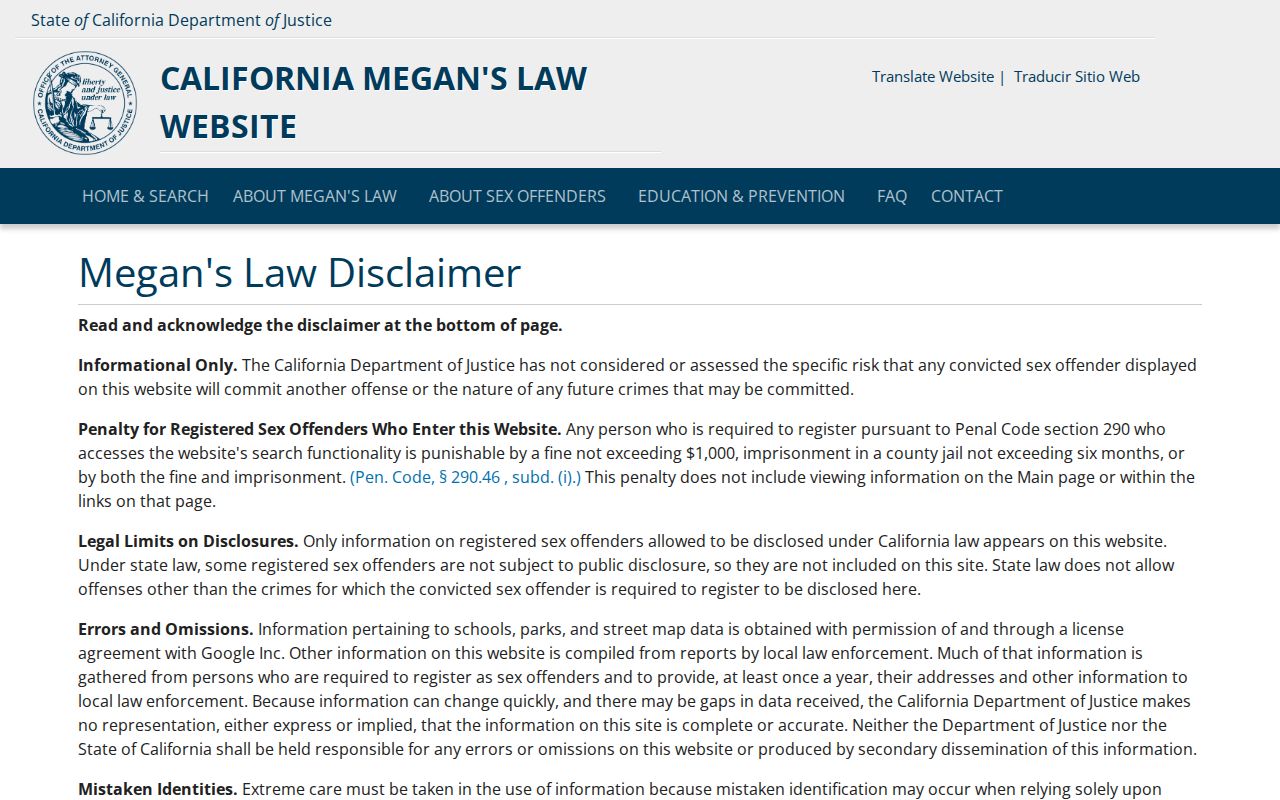
The warning is part of the access path; still check the category, date and identity of a possible match.
Lawful personal use. Use public records for family history, reconnecting, civic research or another lawful personal purpose. Do not use a result to stalk, harass, threaten or expose a protected person. California law restricts misuse of registry information, and an uncertain name match is not a reason to contact or confront anyone.
California's 2026 DROP Privacy Path
The California Privacy Protection Agency's Delete Act/DROP tool launched January 1, 2026. Consumers can submit one verifiable deletion request to registered data brokers; it is a privacy tool, not a way to search for residents. See the CPPA's DROP rules.
The registered-broker list can be filtered by data collected, sold or shared. From August 1, 2026, registered brokers must access DROP at least every 45 days. Consumers can use it to limit covered data circulation, not to verify an address.