
Finding California Residents
A useful search begins with the record that can answer the question. An address usually points first to a county assessor or parcel map. A recorded document number belongs with that county’s recorder. A name tied to a case belongs with the Superior Court for the county where it was filed. For an older household, a local library may hold a directory or phone book that no current portal can replace. California’s agencies are split among 58 counties and state offices, so the first task is to place the event, parcel, or old address in the right county.
The California residents directory search path is strongest when each result is treated as a lead with a date and a keeper. An assessor entry can identify a parcel and sometimes an owner, but it does not count everyone living there. A deed names parties to a transfer, not the full household. Voter access is limited by law, and a library directory records a publisher’s report for a particular year. Use a second source to check a match before drawing a conclusion.
- For a current street address, identify the county and search its assessor or GIS viewer for the parcel number.
- Use that parcel number or the owner name to find the right recorder index and the deed that supports the property history.
- For a court lead, select the county Superior Court through the California Courts directory, then check its public search or courthouse terminal.
- For a past resident, search a local library directory and compare the year and address with census, newspaper, or deed evidence.
- If an existing public record is not online, ask the office that holds it about inspection, copies, mail service, or a California Public Records Act request.
California Resident Records Offices
There is no single California office that holds a list of residents. County assessors, recorders, elections offices, clerks, and Superior Courts keep separate records, while state agencies maintain vital records, voter tools, archives, and professional licenses. The California county registrar and recorder directory helps locate the local custodian for a birth, deed, or marriage record. For a street-by-street property trail, the California street directory page explains how assessor, map, and deed sources fit together.
California State Archives
Local government record guides
County series and historical finding aids
Contact and access vary by collection
California Vital Records
California Department of Public Health
State and county copy channels
(916) 558-1784
Birth, death, and marriage copy channels
California Elections
Secretary of State and county offices
County contact routes vary
Use the voter’s own status tool
Own-record status lookup
California Has No Master Resident Roll
California’s statewide systems answer narrow questions. The Secretary of State checks a voter’s own registration. The Department of Public Health issues specified vital-record copies. The courts route users to one of 58 county Superior Courts. The Secretary of State also lists businesses, while licensing boards keep professional records. None is a statewide name-and-home-address roll.
Most address work starts locally because the assessor maps a parcel and the recorder indexes documents filed in that county. The same person may appear in several counties over time, and a birth, marriage, property transfer, and court case may each have a different custodian. Choose the county where the record was created or the property lies, then expand the search only when another source points to a second place. This avoids treating one county’s portal as a statewide service.
California Property Records by Address
County assessor sites differ in what they let a reader search. Santa Clara County’s Real Property Search offers simple address, advanced address, and assessor parcel number (APN) modes. In its advanced form, the fields are split into street number, direction, name, type, unit, and city; the APN accepts a number with or without dashes. The page asks users to accept its terms before searching. That form is a useful example of why a partial street line or an omitted unit can change a result.
| Santa Clara search mode | Fields or format recorded |
|---|---|
| Simple address | Property address, terms checkbox, Search |
| Advanced address | Street number, direction, street name, type, unit, and city |
| APN | Eight digits or a dashed parcel format, such as 12345678 or 123-45-678 |
- APN
- The assessor parcel number used to identify a mapped tax parcel.
- Situs address
- The property location shown in an assessor record, which may differ from the owner’s mailing address.
- Recorder index
- A name or document-based list that points to recorded instruments; it is not itself a full copy of the deed.
- Criss-cross directory
- A reverse directory arranged by street or address so a researcher can look for a name tied to a place.
- Property roll
- An assessor’s record of parcels and assessment details, which is not a list of every person at an address.
The Santa Clara search page says to enter the property address, not a mailing address. Los Angeles uses its own Assessor Portal for an address or Assessor Identification Number (AIN) search; its map help warns that corner sites, multi-unit properties, and newer developments can be hard to match. These are county examples, not a shared California tool. The full address workflow belongs on the street directory page.
Current California Resident Directories
Current California resident directories are separate source types, not one searchable book. Each row below describes a record that can connect a name, parcel, organization, or election record to a place. None alone proves who currently lives in a household. Keep the record date and the office that supplied it with every finding.
| Source | What It Can Connect | Keeper | Access |
|---|---|---|---|
| Assessor parcel record | Parcel, assessment, and sometimes owner or mailing details | County assessor | County-specific portal or office |
| Recorder index | Parties and dates on recorded instruments | County recorder | Online, office, or paper indexes vary |
| Voter status | A voter’s own registration and election details | State or county elections office | Self-service status tool |
| Qualified voter file | Specified registration fields for a permitted purpose | Secretary of State or county | Application and use limits apply |
| Business or license record | Entity, license, agent, or public business contact | State or local office | Official portal; not proof of residence |
A business filing or professional license can help confirm a public role, but its address may be a mailing location, agent, office, or license contact. An association may publish its contact page while keeping its membership list private. For household history, use dated directory, census, or deed evidence rather than adding office and organization lists together as if they counted residents.
California Voter Files Have Limits
The Secretary of State’s voter-status service is for a voter to check their own registration, registered name and party preference, polling place, and ballot status. The authentication page requires an exact match using California driver-license or identification details, or the last four digits of a Social Security number, depending on the record. It is not a public lookup for everyone registered at a street address.
A different route exists for qualified requestors seeking voter-file data for an election, political, scholarly, journalistic, or governmental purpose. The official voter-file request instructions require the requester’s identity, intended use, current government photo ID, and wet signature; submit by mail or in person. The file excludes driver-license numbers, Social Security digits, signatures, and ballot choices. California treats voter records as controlled-use information, not a general resident directory.
California Deed Indexes Follow Counties
California has no statewide deed index. County recorders organize documents by the names of parties and by the recording system used in that office, so an address alone may not be enough. Los Angeles County’s official records instructions say its real-estate records begin in 1851, with older indexes from 1851–1957 and later material from 1958 onward available at the Norwalk headquarters by appointment. The county says there is no internet index or image search; a reader needs a name and likely recording year.
San Diego County offers a different route: an online official-record index from 1970 to the present, but the web view supplies index information rather than document images. The county says APN searching was removed; images are viewed at public kiosks or purchased through its copy process. These examples show why a California search must follow the county’s access path. A deed, lien, reconveyance, or easement can identify a recorded party, but it does not list every person who occupied the property.
California Court Searches Start Locally
California’s trial-court records are held by county Superior Courts. The statewide Find My Court directory routes a reader to the correct county court, but it does not contain the case files. Search options, fees, online dates, and copy rules vary by court and case type. A public index can surface a case number or filing date; it cannot by itself establish identity, outcome, or current status.
Orange County’s inspected name search requires an account and paid credits, refreshes daily, and returns matching case numbers and filing dates. Sealed matters, juvenile cases, and other restricted categories are excluded. In a recent statewide example, the Los Angeles Superior Court consolidated access portal launched on August 4, 2026 for several case categories, while keeping record-specific access limits. If a portal gives too little detail, courthouse public terminals and the clerk’s copy process are the next channels.
California Vital Records Need Care
California birth, death, fetal-death, still-birth, marriage, and divorce records have different custodians. A local registrar handles current-year and one-prior-year births and deaths. County recorders hold birth and death copies for all years and public marriage records for the county where the license was issued. Confidential marriage records go to that county’s clerk, while a divorce decree comes from the Superior Court. The CDPH forms page lists the current applications, including VS 111, VS 112, VS 113A, VS 113B, and the sworn statement form VS 20.
Authorized copies require the listed relationship or authority and a notarized sworn statement; informational certified copies are marked as not valid to establish identity. The 2026 CDPH fees vary by record type, and its published average for a certified copy is four to six weeks. County offices may be faster or use different local forms. CDPH does not provide a simple rule that makes every old record open after one fixed number of years, so check the right index, archive, and eligibility path.
California Business Records Mark Roles
State business and license files can help distinguish people with the same name, but they identify an entity or professional role rather than a home. BizFile Online can show a company number, formation date, status, jurisdiction, business or mailing address, registered agent, and names of officers or managers when filed. A public address in that record may belong to the organization or its agent. It should not be read as the person’s residence.
The Secretary of State’s BizFile business search includes entity data and many imaged filings; certificates and certified copies follow a separate order process. The screenshot below shows the public search entry point.
Use an entity or license number as the stable key, then compare the filing date and status before relying on a name match. Those checks help keep business information separate from a current-resident claim.
California Privacy Shapes Searches
Some missing details are protected by law rather than absent from every record. California restricts voter-file use, DMV information, juvenile and adoption files, sealed cases, confidential vital-record sections, and Safe at Home addresses. The Secretary of State’s confidential-address program gives eligible participants a substitute mailing address and a confidential-voter option. It does not erase every property record, so readers should not try to infer a protected home from other clues.
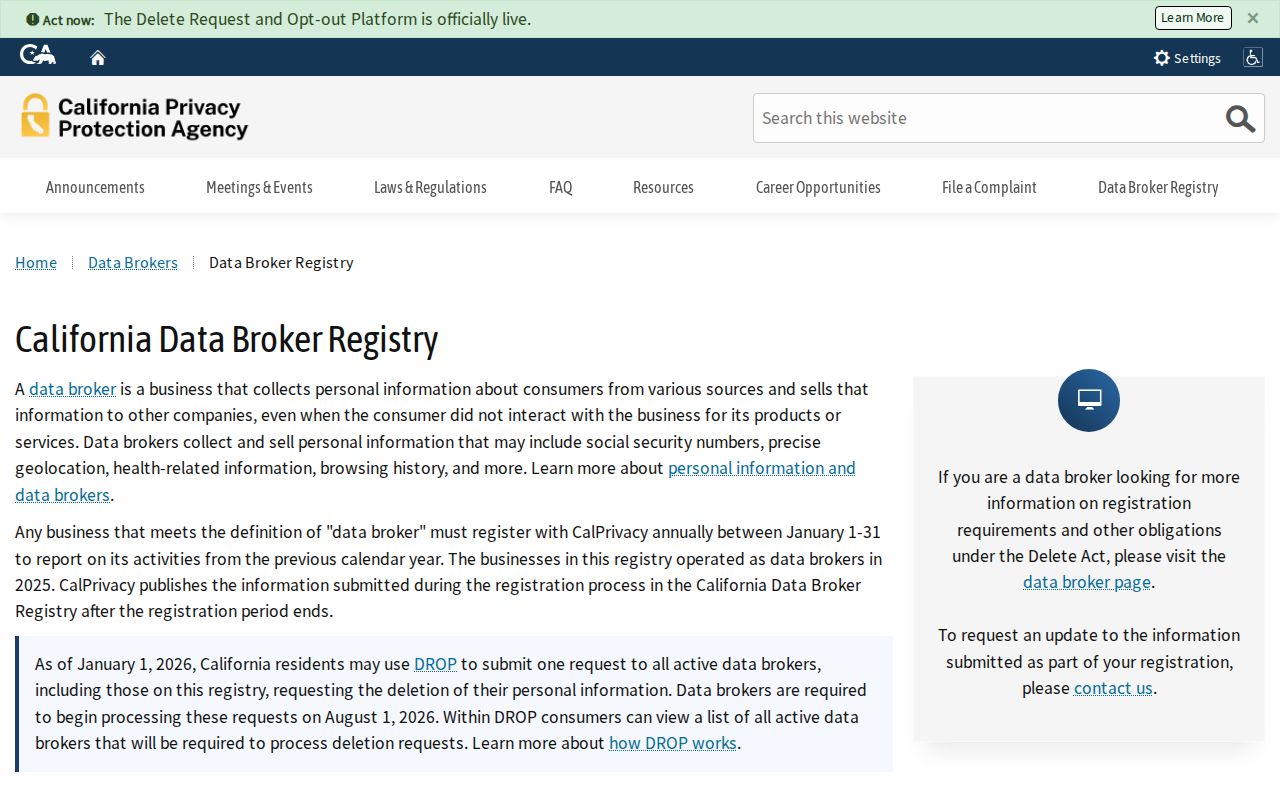
People who want to reduce the spread of broker-held profiles have a separate consumer channel. The California Privacy Protection Agency’s Delete Act registry supports one verified deletion request to registered data brokers; it launched in 2026 and is a privacy tool, not a resident search. Its filters let consumers review broker categories and data practices.
The California data-broker registry shows the public filter page. It is useful when a person wants to manage how a private company handles information, while public-record corrections still go to the government office that keeps the record.
A public record is not permission to publish a private person’s address or use a result to intimidate, stalk, or harass anyone.
| Route | Useful for | What it cannot establish |
|---|---|---|
| Official county or state record | A dated filing, parcel, case, or eligibility-limited record | Every current occupant or a complete household |
| Commercial compiled search | A broad pointer that may suggest another source to check | Reliable identity, current residence, or a verified official result |
Use records with care. California public records support lawful family, property, and civic research. Do not use a name or address to stalk, threaten, or harm a person, and verify sensitive details with the custodian.
Historical California Resident Directories
California’s historical resident directories can bridge the gap between a modern parcel and an older household, but holdings depend on city and year. San Francisco Public Library lists city directories from 1850–1960 on microform and 1875–1982 in print. Reverse directories begin in 1953, with later Haines volumes listed as well. Its year-by-year guide names publishers and calls out gaps. The State Library’s city and county database is a discovery tool; a result may point to a physical volume or another holding instead of a scanned page.
Los Angeles Public Library has a searchable city and street-address directory collection covering 1875–1987, with early volumes visible from 1873. A reverse directory can start from a street address and suggest a name; a forward directory can then follow the person and listed work or family clues. Read the volume’s own key because abbreviations differ. For complete year runs, collection locations, and a method for tracing one household, use the California city directory collection guide.
California Directories Fill Census Gaps
Federal census schedules from 1790–1950 are public under the 72-year release rule, but some gaps matter in California. The 1890 population schedules were mostly destroyed in a 1921 fire. San Francisco’s 1850 census was also lost, along with the 1850 schedules for Contra Costa and Santa Clara Counties. A city directory may therefore be an early surviving address clue where a census page cannot help.
Directories and census schedules answer different questions. A directory gives a name-address association reported by a publisher for a particular issue; census schedules can show age, birthplace, relationship, and other household details for a census date. Neither proves continuous residence between years. Compare a directory entry with deeds, newspapers, probate, or a later census, and keep the year and city with each note so a similar name does not become a false match.
California ZIPs Are Not Neighborhoods
A ZIP code is a USPS delivery label, while a Census ZIP Code Tabulation Area (ZCTA) is a statistical approximation. The two geographies can differ, and neither is the same as a city boundary or neighborhood. California’s 2024 Census Gazetteer extract contains 1,802 ZCTA codes in the conventional 90001–96199 range, but that is not a count of every USPS ZIP. Some PO Box-only and unique postal codes have no matching ZCTA.
Use USPS to confirm the delivery ZIP for an exact address and Census geography files for statistical comparisons. A county assessor may search by address or APN without a ZIP field; a recorder may search by party name, date, book/page, document number, or map. A ZIP alone is too broad to show who lives at a location. Prefix groups can help orient a statewide search, but they do not mark county or city borders.
California Public Records Request Path
When an online search ends, the next step is usually an office counter, terminal, phone call, mail form, library desk, or archive request. For deeds, contact the county recorder; for assessment fields, the county assessor; for a case file, the Superior Court clerk; and for a city permit, the city or county department that issued it. California’s Public Records Act request guidance explains how to ask for an existing record. Send the request to the agency that holds it, not a central office that cannot search every county.
A request should name the record type, place, date range, parcel or case number if known, and preferred inspection or copy format. An agency generally decides within 10 days whether the request seeks disclosable records and may extend that period by up to 14 days in specified cases. It need not create a new report or do research for the requester. Inspection is generally free, while direct-copy costs may apply. If a California resident-directory search yields no result, record the exact portal, fields, and coverage dates before moving to the counter or a library.