
California Previous Resident Sources by Era
California has no statewide deed index or shared date when counties moved records online. Use the county recorder directory to find the local custodian. Pair parcel records with dated deeds, directories, census schedules, and maps. These inspected examples do not set every county’s or library’s years, formats, or request rules.
| Source | Years It Covers | Where Held | What It Shows |
|---|---|---|---|
| Los Angeles County deed records | 1851 onward; index access is split between 1851-1957 and 1958-present | Registrar-Recorder/County Clerk, Norwalk | Recorded instruments indexed by name and year; no internet index |
| San Diego official records | Online index 1970-present | County recorder portal and public kiosks | Indexed document details; web images are not provided |
| Imperial County RecorderWorks | Online index from 1986 | County RecorderWorks portal | Grantor/grantee and document search details |
| City and reverse directories | SF: city directories 1850-1982; reverse runs 1953-1982. LAPL: searchable 1875-1987, early items from 1873 | SFPL, LAPL, State Library, and other local collections | A dated name or address association |
| Federal census | 1790-1950 public under the 72-year rule | National Archives and library databases | Household snapshot, with fields that vary by schedule |
| Sanborn fire-insurance maps | Collection begins in 1867 | Library of Congress and libraries | Building form and use, not occupants or title |
| Building permits | No statewide start year located | City or county building department | Permit applicants and project details, subject to local files |
For recent ownership, start with the county assessor or parcel viewer, then check the recorder’s method. Older household research turns to reverse directories and census years. A web index’s start date does not mean earlier deeds are absent; ask the office or archive about paper indexes, microfilm, or deed books.
Walk California Deed Records Backward
A county assessor or GIS viewer can map an address to an Assessor Parcel Number (APN), the parcel key used in many county records. Some California counties restrict owner names online. The Los Angeles Assessor Portal accepts an Assessor Identification Number (AIN) or address; its recorder index sorts by party and year, not street. Start from a verified parcel and deed. The legal description and document number can bridge older address forms.
- Search the county assessor by address or APN. Record the parcel ID and exact situs address, the address assigned to the parcel; note if the owner field is limited or absent.
- Use the deed, parcel history, or recorder index to identify the latest transfer document and its recording date.
- Read the parties and legal description. The grantee is the party receiving the recorded interest; the grantor is the party conveying it.
- Search the earlier grantee in the recorder’s index to find a prior transfer. Confirm the name with the parcel description and date.
- Repeat until the online index ends, then ask the recorder about paper indexes, microfilm, deed books, or older county series.
A deed chain follows recorded interests, not every person who used an address. Some transfers also come through a probate matter or court order, so a name sequence may need context from another county file. Keep the document number and recording date with each link in the chain.
- Grantor and grantee
- The recorded parties who transfer and receive an interest in a document; the exact role depends on the instrument.
- Chain of title
- The linked sequence of recorded transfers and other title documents for a parcel.
- Legal description
- The land description in the instrument, which can identify a parcel even when a street name or number changes.
Imperial RecorderWorks as a County Example
Imperial County’s RecorderWorks is a representative county example, not a statewide portal. Its index begins in 1986 and searches by document number, book and page, party name, map, or predefined search. A document number starts with its four-digit year. Name search requires a last name; the portal recommends a partial first name to reduce timeouts. Results offer 10, 20, 50, or 100 items per page, display options, and thumbnails. Selected records can enter a shopping cart for the county’s copy process.
The Imperial County RecorderWorks index shows the search modes described here. Do not treat its 1986 start date or cart workflow as California-wide coverage.
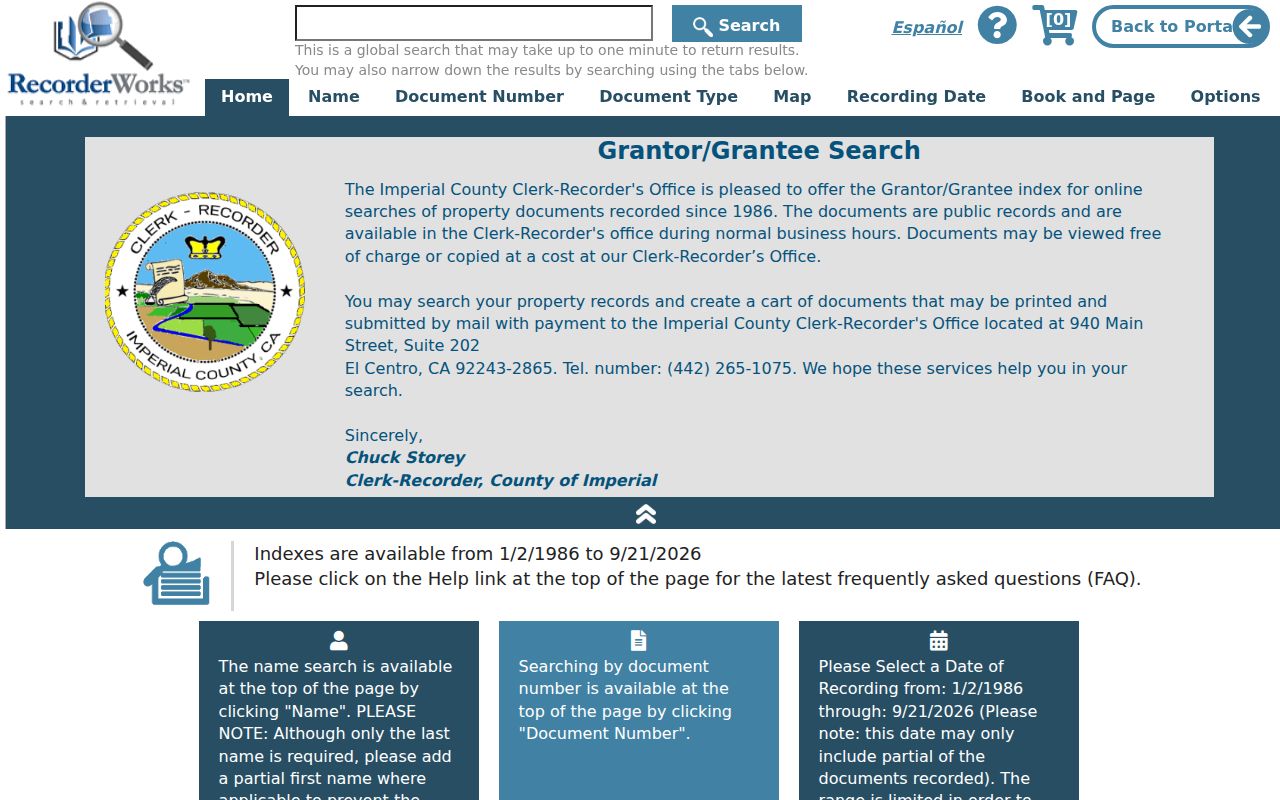
In the screenshot, party, document, book and page, map, date, and type options lead to separate index paths; images and copies follow county rules.
| Party name | Name as indexed; selecting it can list related records by type and date. |
|---|---|
| Document number | Full number begins with the four-digit year; opening it leads to record detail. |
| Recording date and type | Date pair and document-type filters narrow the index results. |
| Description and image control | Short description, thumbnail indicator, selection box, and cart action may appear. |
California Recorder Indexes Differ by County
Los Angeles County offers a sharp contrast with Imperial. Its official real-estate record viewing page describes records from 1851 onward, with alphabetical name-and-year indexes for 1851-1957 in the lower level and 1958-present on the second floor at Norwalk Headquarters. There is no internet index or image search. Researchers use the public viewing area by appointment, up to two weeks ahead, and work from grantor, grantee, and year. A phone index search is not offered.
Los Angeles takes recorder copy requests by mail and points to a third-party online copy-order route; the county says processing may take 20 working days. Its posted schedule lists the first conformed copy as free, then $5 for the first page and $3 for each additional page; certified-copy charges vary by document. These are Los Angeles rules only, so check the current schedule before ordering.
San Diego’s official-record index reaches 1970-present online, but the web search provides indexed data rather than document images. The county points to public kiosks or purchased copies, and APN search was removed. Its recording page lists (619) 238-8158 for assistance. Taken together, the Los Angeles, San Diego, and Imperial examples show why a California address search must name the county and distinguish an online index from an image or certified copy.
Pair California Directory and Census Years
Deeds track title, not the full household. To find previous residents, pair a reverse directory’s address listing with the nearest census, then follow the name in the alphabetic section. SFPL’s city directory formats run from 1850 to 1982, with reverse books from 1953; LAPL’s searchable address and city volumes cover 1875-1987, with early holdings from 1873. The California city directory collections page details those shelves and catalog routes.
SFPL’s house-history research guide uses a reverse listing to find an occupant, then a forward directory to follow the name before checking deeds, tax material, census, newspapers, and probate. That sequence keeps the one-address trail focused while leaving the full collection ranges to the directory page.
- Write down the address, parcel ID, and date range before searching older volumes.
- Look in the reverse or street-order directory for a name tied to that address.
- Open the same year’s alphabetic section to capture household notes and any listed occupation or business address.
- Compare the result with the nearest public census schedule. Record a census address and household members as a separate dated source.
- Check an obituary, newspaper, cemetery record, or probate file to confirm a family relationship or later move.
A city-directory year and a census year do not share a single reference date. Each publisher’s compilation period and each census schedule’s enumeration date matter. Keep a short chronology with the exact title, volume, page, and source date for every match.
Sanborn Maps for California House History
Sanborn fire-insurance maps, historical maps first made for insurance work, add building context between directory entries. The Library of Congress guide says the collection begins in 1867 and offers searches by state, city, date, sheet, and notes. An inspected 1906 Los Angeles volume has 113 sheets. A map may show a building footprint, material, stories, roof, openings, fire walls, and sometimes the structure’s use.
Publication, survey, and correction dates may differ. Maps can test a change between two dated records, but they do not name occupants or establish title. Use one with a deed and directory.
The Library of Congress Sanborn search guide describes the fields and atlas-volume finder.
California Address Changes Need Local Proof
No universal California street-renumbering date was located in the official sources reviewed. A current number may not match an older directory if a street was renamed, a building was split into units, an address point changed, or a parcel was divided. Do not guess a statewide conversion year. Build a local link with city maps, the directory’s street list, assessor history, subdivision maps, and the legal description in a recorded deed.
Keep a then-and-now note for each address: the printed form, the modern form, any unit or corner detail, the parcel number, and the evidence that connects them. If a reverse directory has no result, try the prior street name, a nearby number, or the name of a likely owner in the alphabetic section. A no-result screen is a limit of that search, not proof that no one lived there.
Address check: printed street name and number → local map or directory key → parcel identifier → recorded legal description → compare dates and location.
California Permits and Household Clues
Building-permit systems are city or county systems, and no statewide historical start year was located. A permit can name an applicant, owner, contractor, architect, or agent; it does not by itself show who occupied the property. Search the planning or building department by address or parcel, then ask whether older paper files are held at the counter, in a records room, or in an archive. Some portals omit old files altogether.
For a permit, code file, cemetery register, or other local item that is not indexed online, contact the department that keeps it by phone, email, or in person. A California Public Records Act request can ask for an existing disclosable administrative record, but it does not require an office to create a title report or conduct historical research. Local public libraries and county archives can help bridge an older date range when municipal files have not survived or are not digitized.
| Search key | Address or parcel, if the city or county portal offers those fields. |
|---|---|
| Details to note | Permit number, type, status, dates, applicant or contractor, project description, valuation, and inspection history when shown. |
| If no online file appears | Ask the building counter about archived paper files and the agency’s records request path. |
Past California Households: Directories, Census, and Obituaries
Once a deed chain supplies earlier names, use directories and census schedules to ask who was associated with the address. Then look for obituaries, cemetery or funeral-home records, church registers, newspaper notices, and probate material. An obituary can name relatives and a place, while probate may explain a transfer after death; neither alone proves that the person lived at the parcel for a specific span. Keep each source’s date and relationship in the chronology.
The federal 1890 population census was mostly destroyed. San Francisco’s 1850 schedule was also lost, along with those for Contra Costa and Santa Clara. Where an expected census year is missing, use an earlier and later schedule, directories, tax rolls, newspapers, voter registers, or city permits as separate pieces of evidence. A household list in one source should not be treated as complete.
Lawful house history. Use old records for family history, property history, or personal curiosity. Do not turn a historical address into a claim about a living person’s current location, or use the material to track, pressure, or harass someone.